

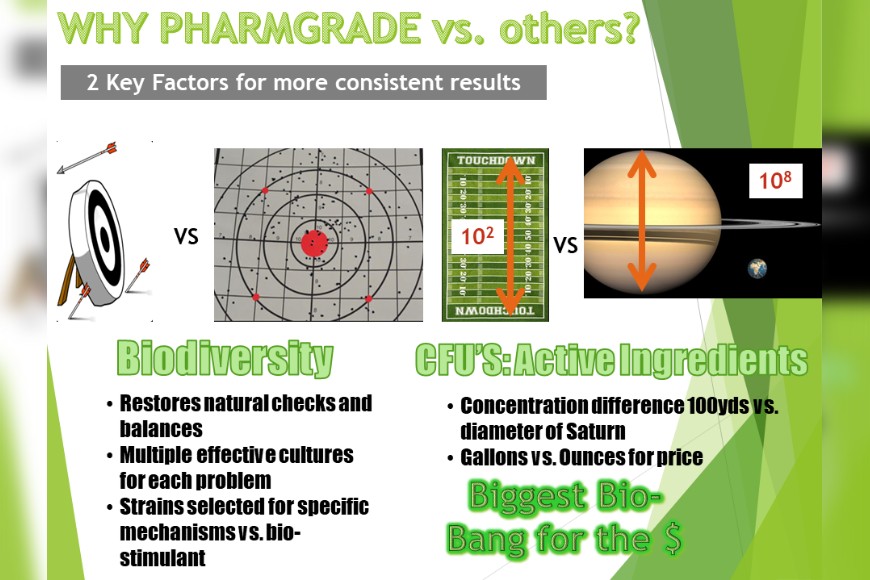
Pharmgrade’s suite of products is the culmination of over 30 years of research and development seeking to understand and harness the power of the biological fraction of the soil to increase crop quality and yield through the improvement of soil health. Compare a Pharmgrade label to any biological inoculant on the market today, and you’ll find it distinguishes itself on two main fronts.
First, Pharmgrade takes a broad-spectrum approach to soil health, introducing over 20 species of known beneficial bacteria and fungi. Most products sold in this space are a single strain aimed at one specific problem or disease rather than addressing the root of the problem: lack of biodiversity in farmed soils.
The organisms in Pharmgrade products can be classified into 3 functional groups: Aerobes, Facultative Anaerobes, and Fungi. Their inclusion into our products is strategic, and each strain has been vetted, trialed, and finally introduced into the mix based on its action. To have made the cut, a specific organism must show improvement in one or more of the following 4 mechanisms:
- Increase Nutrient Availability
- Promotes soil balance and resiliency
- Supports plants’ natural processes
- Reduce Plant Abiotic Stress
Rather than go one by one through each species, let’s review what we have learned about each one of these groups, their strengths, and why we included them in our mix.
Aerobic Bacteria
These bacteria are the ones that use oxygen to run their respiratory chain, as we do. They are more efficient at this as they can use dissolved oxygen in water, much like a fish. If you look at the BIOS label, most of these belong to the Bacillus genus. Bacillus species are known for many functions in the soil, breakdown of organic matter and enzyme production are key contributions from some. Others in this group are great at solubilizing phosphorus, B. Megaterium in particular. From Nitrogen fixation to abiotic stress reduction, this group is a very important part of the Pharmgrade consortium.
Facultative Anaerobic Bacteria
This is a very diverse and interesting group that CAN use oxygen to run their energy chain but can also use other compounds to generate the energy needed in the absence of oxygen. Most of these organisms belong to the Lactobacillus genus. The ability to thrive either with or without oxygen is incredibly useful in the soil matrix, as some areas in the field may have all the oxygen needed, while other areas are in a nearly constant flooded state. Much of the initial research into the group of beneficial Anaerobes comes from rice paddies in the far east and has been tested by time. There is a great literature review of this series of benefits titled “From Yogurt to Yield” that cites 80 peer-reviewed articles dedicated to showing how these versatile bacteria have evolved to help their plant partners. Some of the most interesting research being conducted today is this series’ effect on reducing abiotic plant stresses, including heat, drought, and even high salt content in the soil and water.
Beneficial Fungi
The use of Trichoderma species to enhance soil resiliency is well documented throughout the world. The species of Trichoderma in Pharmgrade products have been selected for their aggressive action in restoring soil balance, as well as covering the bases for soil temperature preference. Since our products are marketed through several different climates, this diversity is key to viability in our soils. Some prefer much warmer soil temperatures, while those isolated from the Alaskan Tundra prefer the cooler soil temperatures of Idaho.
The second distinguishing characteristic of Pharmgrade’s selections in the marketplace, after biodiversity, is the concentration or counts of those organisms guaranteed per ML of product. Our growth and stabilization technology has allowed us to pack more colony-forming units (CFUs) per ML than any other product on the market. Add to those concentrations the fact that our solutions are priced to allow application of many gallons per acre for the same money that our competitors are getting out a quart at a much lower concentration guarantee. The key is to get enough on to make the difference big enough to be noticed. It will help at 3 gallons, 6 will show even better, but 10 leaves no doubt. Keep in mind that we have averaged $4 in return for every dollar spent on our programs for over 20 years. Not many of our competitors want to talk about ROI, but it’s how growers make decisions and how we’ve built our business.
On the back of a lot of teamwork, research, trials, and an eye for continuous improvement, Pharmgrade has positioned itself as the preeminent biological supplier on the market today with cumulative sales of over 6 million gallons. We are proud to bring this technological advancement to your fields and give you another tool in the toolbelt to help you maximize profit on your farm. We’ve always said it must work for the grower first, and he has to get the most value from the product for this to work long term. Here’s to that journey together.
Tyler Tuttle
B.S. Agronomy
Emphasis Soil Microbiology
Chief Commercial Officer Pharmgrade Inc.


